Langrishe Lodge
The Black-Eyed BlondeLangrishe Lodge is the coastal estate belonging to Dorothea Langrishe, Clare Cavendish’s mother, and a major setting in Philip Marlowe’s investigation. At first it appears to embody the security and leisure of the wealthy family that inhabits it. As Marlowe returns, however, its gardens, conservatory, and private rooms become places where Clare’s guarded disclosures, Everett Edwards III’s crisis, and Terry Lennox’s return converge. The house’s stately appearance offers little protection from the secrets and violence unfolding inside it.
Setting and Ownership
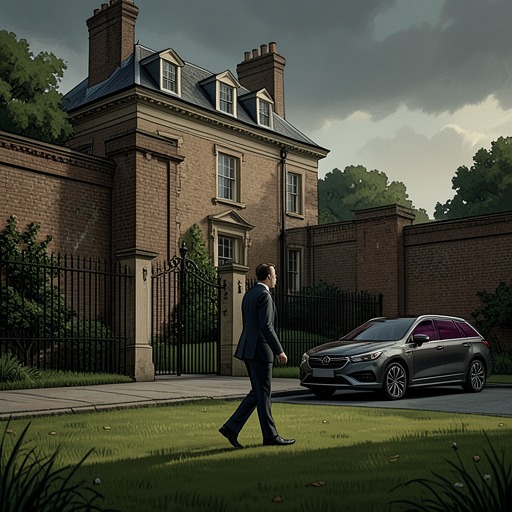
Langrishe Lodge stands in Ocean Heights, where its size and elaborate design distinguish it from an ordinary home. Marlowe sees a large structure of pink and white stone, with turrets, towers, many windows, and a flagpole on the roof. A broad gravel drive approaches the house, while substantial grounds extend around it. The carefully maintained garden, mature trees, and ocean nearby establish the estate as both secluded and conspicuously privileged. Marlowe’s wry comparison between the house and a royal residence, and his thought that manufacturing perfume must be a lucrative business, place the family’s wealth in immediate view.
The interiors reinforce that impression. The rooms Marlowe glimpses through the windows are large and carefully furnished; the conservatory, attached to the rear of the house, is a tall structure of curved glass and steel containing palms. The estate has spaces for leisure and display, including a lawn where Everett moves about with a golf club. Yet Marlowe wonders whether everyday life can be conducted naturally in such a formal setting, or whether ordinary comforts must be confined to designated rooms. His response makes the house more than a marker of wealth: it is a setting in which comfort and intimacy seem subject to the household’s arrangement and appearances.
Although Clare and Richard Cavendish live there, Clare makes clear that the house belongs to her mother, not to her and Richard. She presents that arrangement as one reason for Richard’s moroseness. His presence in a home governed by his mother-in-law’s ownership adds strain to an already uneasy marriage. Langrishe Lodge is therefore not simply the Cavendishes’ private domain; it is a family residence whose ownership helps define the tensions among the people living within it.
Grounds and the Investigation
Marlowe’s first visit brings him through the estate’s public-facing spaces and into its more private ones. Before reaching Clare, he encounters Everett on the lawn, where he is idly striking the heads off daisies with a golf club. In the conservatory, Clare is seated at a wrought-iron table, writing in a leather-bound diary or notebook with a fountain pen. Her quiet activity contrasts with the conspicuous size of the place and the games associated with its grounds. Richard then enters and makes his presence felt without initially acknowledging Marlowe, adding a note of studied indifference to the meeting.
The conservatory also becomes the setting for Clare’s explanation of why she hired Marlowe. She first tells him that Nico Peterson has been reported dead in a hit-and-run, then reveals that she saw him in the street and that he did not appear to be dead. Later, when Marlowe is about to leave, she says she was present when the incident happened. The sequence turns a polished room into the scene of an increasingly consequential disclosure: the case is not merely a search prompted by a death report, but an inquiry into what Clare knows and why she has withheld it.
The garden provides a different kind of privacy. Clare asks Marlowe to walk with her because she thinks better outdoors, and they follow a gravel path from the house toward the trees and the distant ocean. During this walk, she speaks about the sudden recognition of familiar people in unfamiliar circumstances. The subject reflects the problem at the center of her account of Peterson, whose reported death conflicts with what she believes she saw. The walk also permits an intimacy absent from the formal encounter inside the house; Marlowe later remembers that they kissed. When they return, Clare explains that the imposing residence is her mother’s, connecting the family’s domestic arrangement to Richard’s discontent.
A Private Night Emergency
On a later night, Clare asks Marlowe to come without making his arrival known. He enters through the estate’s side and parks near the conservatory, approaching the house in darkness. Clare meets him outside and leads him through open French doors, up a curving staircase, and along a corridor lit by low wall lights. The route takes him from the grounds and conservatory into the family’s private quarters, where the house’s scale and formality give way to a bedroom and an urgent personal crisis.
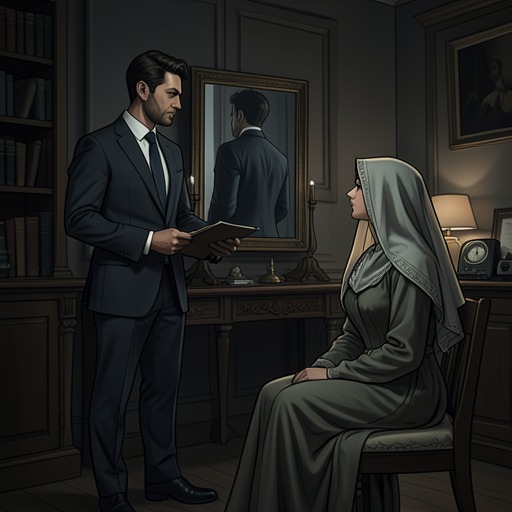
Everett is unconscious on the bed, and Clare says that he has taken something and is sick. Marlowe recognizes the seriousness of his condition and phones Dr. Loring, explaining that discretion is needed because Dorothea Langrishe is involved. Dr. Loring agrees to come to the estate. This episode establishes that the Lodge’s privacy can serve a practical purpose: Clare can summon help for her brother while controlling who learns of the emergency. It also places Marlowe in the role of confidant and intermediary within the family, rather than merely an investigator arriving to discuss Peterson.
The House as the Site of Confrontation
Langrishe Lodge later becomes the destination of Marlowe’s final summons. After learning that Terry Lennox has used Clare to bring him into the Peterson matter, Marlowe phones the house and tells her to have Terry come to him. The call makes Clare the link between Marlowe and the man whose assumed identity and disappearance have shaped the investigation. The Lodge, once the site of Marlowe’s first meeting with the Cavendishes, is again connected to the return of information that had been concealed.
At the final confrontation, Marlowe calls for Terry to come out, and the curtains part to reveal the man Marlowe knew under that name. Clare is present when Terry’s return is exposed. The scene gathers the estate’s family relationships and the investigation’s deceptions into one room: Terry’s hidden identity is no longer merely a matter of Marlowe’s suspicion, and the people connected to him are forced to face his reappearance. When Terry lunges for a glass ashtray, Everett shoots him. Marlowe takes the gun from Everett before he can fire again.
The house’s role has thus shifted from impressive backdrop to intimate refuge and finally to the setting of an irreversible death. Its lawns and conservatory frame Clare’s early disclosures and her developing closeness with Marlowe; its secluded bedroom accommodates the emergency she does not want widely known; and its interior holds the final collision between Terry, Everett, and Marlowe. Langrishe Lodge’s wealth and privacy do not resolve the family’s troubles or keep the investigation outside. Instead, the estate concentrates them, making the place that first seemed insulated from ordinary life the setting where the story’s most consequential secrets and conflicts become impossible to contain.